

Give students a paragraph and they’ll find something to say. Give them a picture and many of them freeze. They describe what they see, stop there, and lose the point. Period 3 is the right time to fix that, and Benjamin Franklin’s “Join, or Die.” is the image I use to do it.
This is the lesson I teach in the first days of the unit, with the short-answer set I built around it.
Why “Join, or Die.” works for an image SAQ
The woodcut appeared in The Pennsylvania Gazette on May 9, 1754, and is attributed to Franklin. It shows a snake cut into eight labeled pieces: S.C., N.C., V., M., P., N.J., N.Y., and N.E. Underneath: “JOIN, or DIE.”
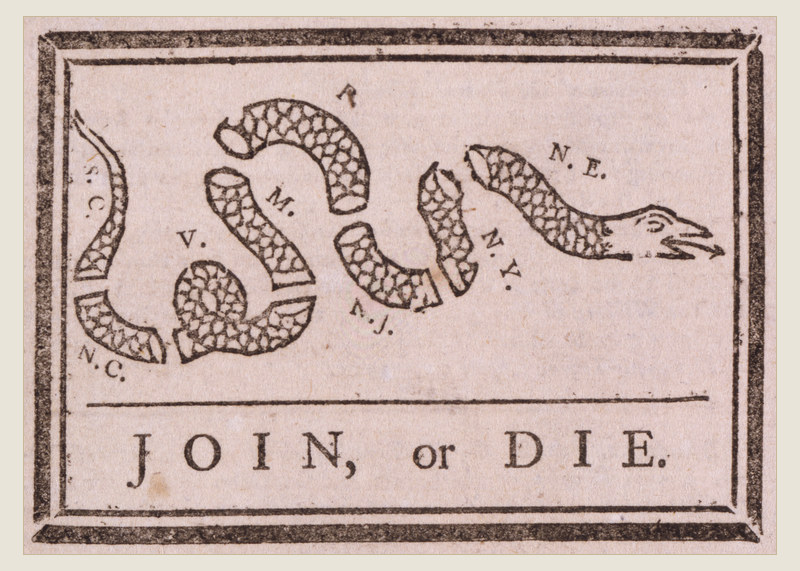
It’s simple enough that every student can describe it, and rich enough that a strong answer has to go well beyond description. It also corrects a misconception I see every year. Students assume the colonies were already “American” and united in 1754. The cartoon shows the opposite: unity had to be argued for.
It opens Period 3 (1754–1800) cleanly, too. It sits at Topics 3.1–3.2, KC-3.1.I: the Seven Years’ War and its fallout.
How the image SAQ fits the exam, in my words
On the May 2027 exam, students answer three required short-answer questions. One is built on a non-text source like an image. Each question has three parts, (a), (b), and (c), and each part is worth one point. I pace each set at about 13 minutes. That’s my summary; check AP® Central for the official details.
No thesis and no conclusion. Students need to answer what’s asked, with specific evidence, and explain the link.
The lesson, step by step
Step 1: Show the image with no caption (5 minutes)
I project the snake with no title, no date, and no source line. Students jot down answers to three questions:
- What do you see?
- Who is the audience?
- What problem is the artist trying to solve?
Taking the caption away makes students look before they label. It also means their first guesses come from the image, which is exactly what the SAQ will ask of them.
Step 2: Run a quick HAPP
Then I reveal the source line and we source it together with HAPP:
- H (historical situation): rising conflict with France in the Ohio Country in 1754
- A (audience): colonial newspaper readers
- P (purpose): persuade the colonies to cooperate
- P (point of view): Franklin, a Pennsylvania printer and colonial official
Step 3: Ask whose voices are missing
This question is on every source page in my units, and here it matters. The snake shows only British colonies. Whose land and nations are missing from this picture of “America” in 1754? The American Indian nations whose land the conflict was about. I put them on the map from the first minute, as political actors, not background scenery. That habit pays off later in the DBQ.
Step 4: Teach the CEE frame
Every SAQ part gets the same structure: Claim → Evidence → Explain. A claim that answers the question, a specific and accurate example, and a sentence that explains the link. Three to five sentences per part is plenty.
Step 5: Write (a), (b), and (c)
These are the three parts in my sampler, each with its own CEE frame:
(a) Briefly describe the historical situation in which this image was created.
Frame: In 1754, ___. The image responds to this by ___.
What I look for: the outbreak of the Seven Years’ War in the Ohio Country; the Albany Congress (1754) and the Albany Plan of Union; or the conflict with France and its American Indian allies.
(b) Briefly explain one purpose the creator likely had in publishing this image.
Frame: The creator wanted ___ because ___. The detail of ___ shows this.
What I look for: persuading divided colonies to cooperate for defense, supporting Franklin’s Albany Plan, or warning that disunity would mean defeat. The best answers tie the purpose to a detail in the image: the cut pieces, the labels, the words underneath.
(c) Briefly explain how colonists used the idea of colonial unity differently between 1765 and 1776 than the image did in 1754.
Frame: In 1754 unity meant ___, but by 1765–1776 colonists used it to ___, for example ___.
What I look for: by 1765–1776, unity was used against Britain, not alongside it. Strong examples are the Stamp Act Congress, committees of correspondence, boycotts, and the Continental Congresses. The snake image itself was reprinted during the resistance of the 1770s.
Part (c) is the hardest. It asks students to see change over time, which is the reasoning that ties all of Period 3 together.
Step 6: Score with points and a level
I score one point per part. Students see the point total next to their standards-based level, never a number by itself. This is my classroom crosswalk, not an official scale:
| Points | SBG level | What it looks like |
|---|---|---|
| 0 | Beginning | No part answered with accurate, specific evidence |
| 1 | Developing | One part answered with a claim + specific evidence |
| 2 | Proficient | Two parts answered; evidence is explained |
| 3 | Exemplary | All three parts: claim, specific evidence, clear explanation |
Mistakes I watch for
- Describing without connecting. “There is a snake in pieces” isn’t an answer to (a). For an image, students describe what they see and then connect it to its historical situation.
- Mixing up HAPP’s “H” and contextualization. “H” is the situation of this one image. In an essay, contextualization is the broader picture. On an SAQ, students just need the specific situation.
- Treating 1754 and 1776 as the same unity. In 1754, unity meant cooperating within the empire against France. By the 1770s it meant resisting Britain. If a student’s (c) misses that turn, it misses the point.
- Writing an essay. Each part is labeled and answered on its own. No intro, no thesis.
Where it goes next
In my U.S. History Period 3 (1754–1800) unit, this image is SAQ 3 of three source-based sets in exam order: two historians (John Fiske, 1888, and Charles A. Beard, 1913), a primary text (the Northwest Ordinance, 1787), and this image. It also opens the unit as the Day 1 warm-up for Topic 3.1. The same CEE frames and crosswalk carry into the seven-document DBQ and the LEQ.
In my U.S. History Period 4 (1800–1848) unit, the image SAQ is “King Andrew the First” (1833), also from the Library of Congress. Students who learned the routine on the snake already know what to do with Jackson.
Get the free “Join, or Die.” SAQ
Tasting Flight No. 3 is this lesson’s student page, free: the image with its full source line, all three parts with CEE frames, the student SAQ checklist, and the points-to-SBG crosswalk. It comes in full color and a low-ink version for the copy room.

Get Tasting Flight No. 3 and the other free samplers →
For the full Period 3 sequence, and the Period 4 unit that follows it:
- U.S. History Period 3 (1754–1800) Unit: DBQ, SAQ, LEQ & Lessons (AP®-aligned)
- U.S. History Period 4 (1800–1848) Unit: DBQ, SAQ, LEQ & Lessons (AP®-aligned)
— Shauna
AP® is a trademark registered by the College Board, which is not affiliated with, and does not endorse, this product.
Leave a Reply