

The DBQ is the essay I most want to grade well, and it’s also the easiest one to let pile up. Seven documents, a timed write, and a stack of essays that each need real feedback. What helps most isn’t reading faster. It’s a better rubric: one that tells me where to look, tells students what to fix, and gives me a grade I can defend.
Here is the system I use, built from my standards-based DBQ rubric and the DBQ workshops in my U.S. History units.
Why I use a standards-based DBQ rubric
A DBQ score out of 7 tells a student how many points they earned. It doesn’t tell them which skill to work on next. A standards-based rubric does, because every row is a skill and every skill is described at four levels:
- 1 Beginning: below standard; targeted support needed
- 2 Developing: approaching standard; more practice needed
- 3 Proficient: meets standard. This is the goal.
- 4 Exemplary: exceeds standard; deep, transferable mastery
I say this to students early and often: a 3 is mastery. A 4 is above and beyond, not the expectation.
My DBQ & Historical Argument rubric has six skill rows:
- Thesis / Claim
- Contextualization
- Evidence: Document Use
- Evidence: Outside Knowledge
- Sourcing
- Complexity & Historical Reasoning
The rows follow the categories the exam scores, and each row is a skill I can reteach on its own. On the two evidence-count rows, this is what Proficient asks for, in the rubric’s words:
- Evidence: Document Use, Proficient: “At least three documents are accurately used as evidence. Each is connected to the thesis with explanation of how it supports the argument.”
- Sourcing, Proficient: “At least one document is sourced with explanation of how the author’s historical situation, purpose, or audience shapes the document’s usefulness as evidence.”

How the DBQ is scored, in my words
On the May 2027 exam, the DBQ is one question with seven documents. Students get 60 minutes, which includes a 15-minute reading period, and the essay is scored out of 7. How I break it down for students:
- Thesis (1): a defensible claim that answers the exact prompt and sets up a line of reasoning
- Contextualization (1): the bigger picture before, during, or after the prompt’s time frame, connected to the argument
- Evidence from the documents (2): one point for accurately describing at least three documents, two for using at least four to support an argument
- Evidence beyond the documents (1): one specific example that isn’t in the packet, explained
- Sourcing (1): for at least two documents, explain why the historical situation, audience, purpose, or point of view matters to the argument
- Complexity (1): a complex understanding sustained across the essay
That’s my summary, not official language. Check AP® Central for the official details.
The two rules students miss most
- The four-document rule. Three documents earns the first evidence point. Students need four or more used as evidence to earn both.
- The two-sourced-documents rule. Sourcing one document isn’t enough. Students need to explain HAPP (Historical situation, Audience, Purpose, Point of view) for two different documents and tie each one to the argument.
One more: HAPP’s “H” is the situation of one document; contextualization is the broad picture for the whole essay. Cousins, not twins.
How I grade a DBQ fast and fairly: step by step
1. Hand out the rubric before the documents
Students see the rubric before the packet. We walk through what a 3 looks like on each row, and I ask: what’s the difference between a 2 and a 3 here? On sourcing, a 2 attempts sourcing for at least one document but stays at the surface, identifying the author or type. A 3 sources at least one document and explains how the author’s historical situation, purpose, or audience shapes its usefulness as evidence. Once students can say that, I write it in fewer margins.
2. Have students self-assess before they submit
Students mark their level on each row of the self-assessment before turning in the essay. Gaps show up before I read a single response, and my feedback answers their own judgment instead of arriving out of nowhere.
3. Score each row with one evidence note
One sentence per row: name the skill, describe the evidence, point to a next step. My feedback stems do most of the drafting. Two I use constantly:
- Developing, sourcing: “You identified the source, but your sourcing work stayed at the surface. Who wrote this, and how might their position have shaped what they included or left out?”
- Developing, corroboration: “You summarized each document separately. The next step is to put them in conversation: where do they agree? Where do they conflict? What does that tell us?”
“Your sourcing identified the author but didn’t address purpose or how the context shaped the document” is more useful than a number alone.
4. Put the DBQ points and the SBG level side by side
Students always see both. This is the crosswalk I use in my units. It’s my classroom conversion, not an official scale.
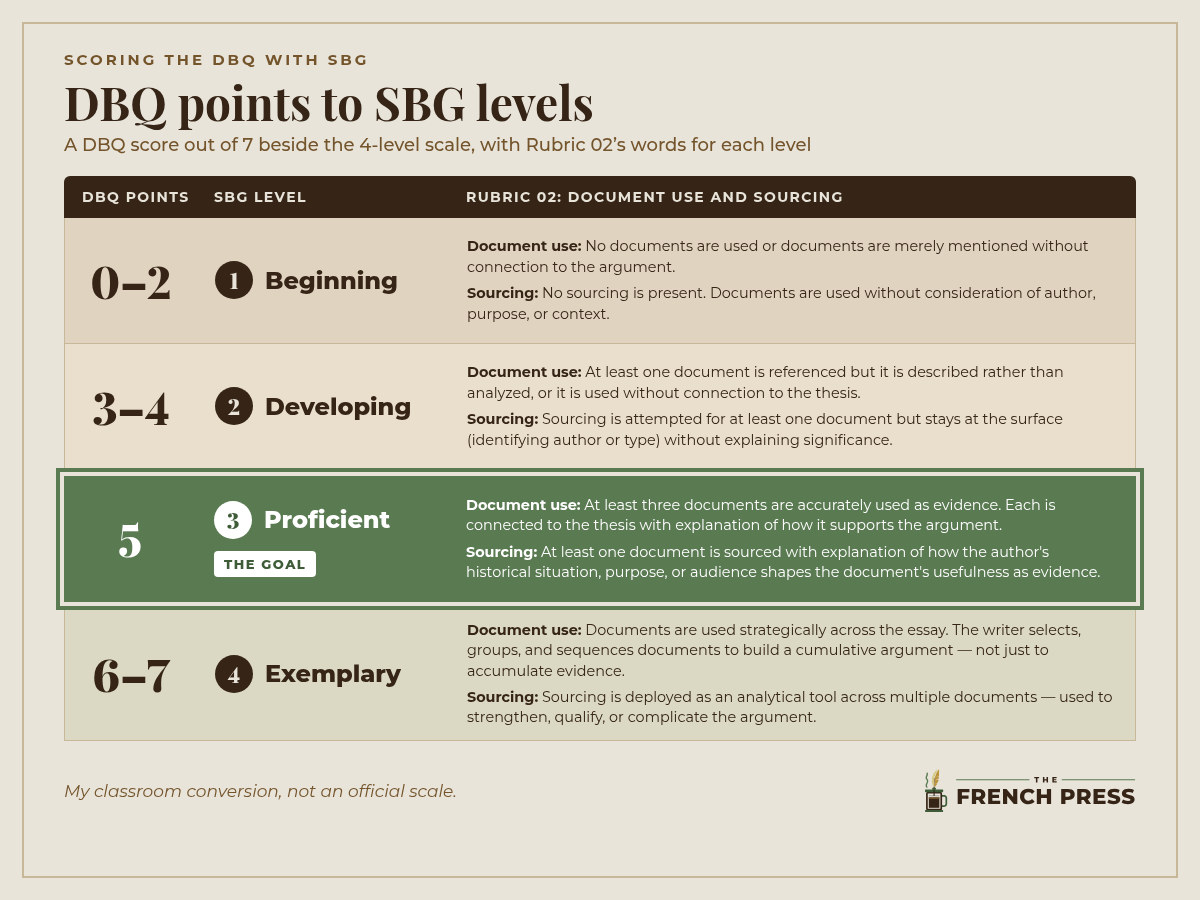
5. Record it once, and don’t average
In my gradebook, the DBQ is one standard (“Historical Argument: DBQ”). I record the SBG level and put the AP® point total in the comment. Under standards-based grading, the most recent and most consistent evidence counts most. I don’t average an October DBQ with a March DBQ. If a student shows Proficient later, Proficient is the score.
6. Build in reassessment and pull the class sheet
A 1 or 2 on a row gets a pathway: revision, an oral explanation, or a retake, logged on the three-attempt tracker. Then I pull the class mastery sheet. A pattern of 2s on sourcing needs a different reteach than a pattern of 2s on corroboration.
Fairness checks I build in
- Calibrate with one sample before the stack. Before I start, I reread the sample thesis in my scoring notes that earns the point. That way the first essay and the last one are held to the same line.
- Same rubric, same rows, all year. One shared language for what a 3 looks like.
- Make room for the voices that unlock complexity. “Whose voices are missing?” is on every source page in my units. It isn’t a gotcha. It’s how students reach the complexity point: showing how different groups experienced the same change.
What this looks like in my Period 3 and Period 4 units
In my U.S. History Period 3 (1754–1800) unit, the DBQ asks students to evaluate the extent to which the American Revolution transformed American society, and not only American politics, from 1774 to 1800. The seven documents run from Phillis Wheatley’s 1774 letter to the Rev. Samson Occom to the Seneca chiefs’ 1790 speech to President Washington (KC-3.2.I, KC-3.2.II, KC-3.3.I). Before they write, students sort the documents into four groups on a grouping organizer: ideals that opened doors, changes in law, limits and continuities, and power and land. Those groups line up with the evidence and complexity rows, so I know where to look when I score.
In my U.S. History Period 4 (1800–1848) unit, the DBQ asks students to evaluate the relative importance of the causes of the reform movements from 1820 to 1848, using Garrison, Finney, Angelina Grimké, Dorothea Dix, Frederick Douglass, the Seneca Falls convention, and Horace Mann. Same rubric, same crosswalk, same complexity moves card.
Try it free: the Tasting Flight
To see the scoring structure first, start with a free Tasting Flight sampler. Tasting Flight No. 3 is a one-page “Join, or Die.” image SAQ from my Period 3 unit, with Claim–Evidence–Explain frames and the AP® points-to-SBG crosswalk. Tasting Flight No. 2 is four rows of my SBG Argumentative Writing rubric, with a self-assessment row and feedback stems.
Get the free Tasting Flight samplers →
When you’re ready for the full DBQ workshop:
- U.S. History Period 3 (1754–1800) Unit: DBQ, SAQ, LEQ & Lessons (AP®-aligned)
- U.S. History Period 4 (1800–1848) Unit: DBQ, SAQ, LEQ & Lessons (AP®-aligned)
- SBG Rubric Bundle: Social Studies (includes the full DBQ & Historical Argument rubric)
- SBG Writing Rubric Bundle: ELA (for argument writing outside history)
— Shauna
AP® is a trademark registered by the College Board, which is not affiliated with, and does not endorse, this product.
Leave a Reply